
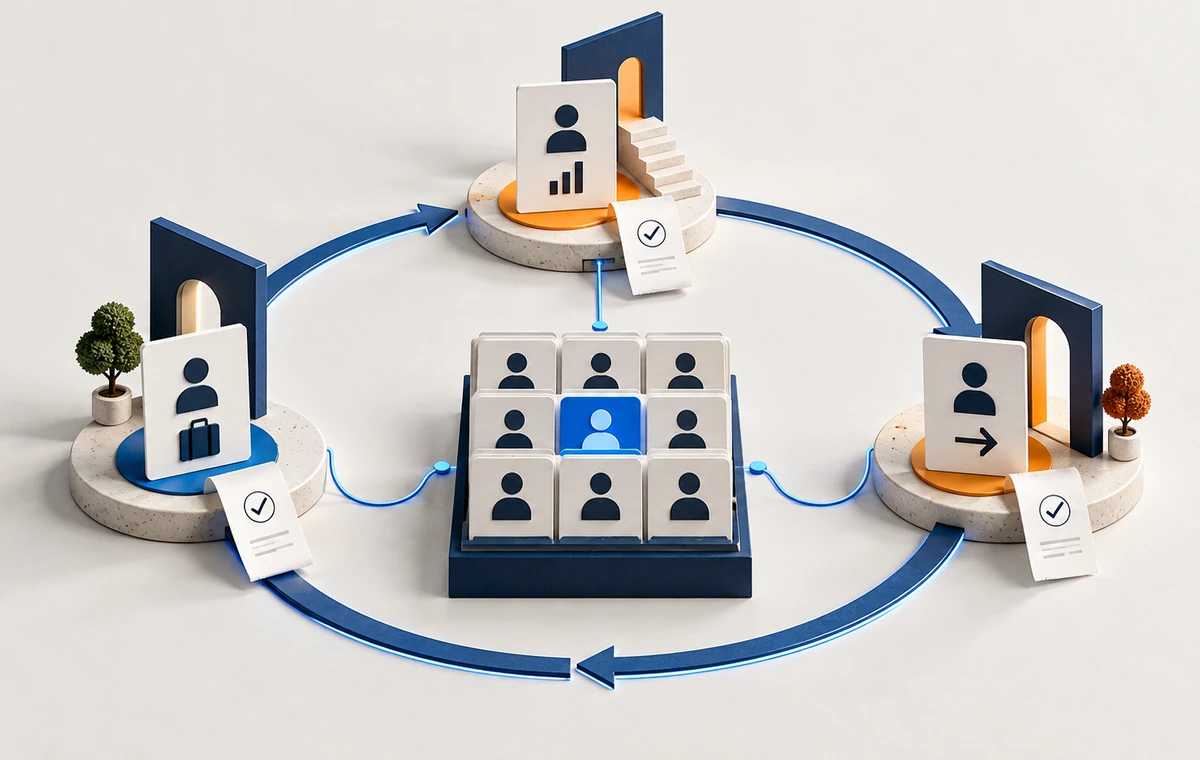
A directory can show the right employee today and still fail the next time that employee changes role. The problem is not necessarily the display. It is the connection between a business event, the source record and the work required in other systems. Joiner, mover, and leaver events test that connection.
Joiner, mover, and leaver processes provide a practical structure for that connection. They establish when employment or responsibility changes, who authorizes the change and which actions must follow. The directory should reflect the resulting organizational state, while the workflow preserves what people requested, approved, and completed.
This requires more than copying fields on a schedule. HR can approve a person to join before an account exists. A mover can retain several independent responsibilities. A leaver’s final working day can arrive while an access-removal task remains unresolved. Each case needs an explicit state and an accountable owner.
A joiner begins before the identity exists
Among joiner, mover, and leaver events, pre-hire work often starts with a future employee record. The organization knows an intended start date, manager, location and required role before anyone creates a Microsoft Entra ID account. Treating an account as the only possible starting point pushes important decisions later than necessary.
The pre-hire record should have a stable reference and a clear status. Do not confuse it with an active employee who is already available for work. The process should identify which information has approval, which remains provisional and which actions depend on later confirmation.
Microsoft’s HR-driven provisioning documentation describes supported patterns for connecting employment information to identity lifecycle processes. The integration still depends on mappings, source data and configuration appropriate to the customer. Microsoft Workday integration reference
The operating design should link the future employee, approved request and eventual account. Without that link, service teams may create duplicate records or lose the evidence explaining why someone assigned the access.
Assess readiness against the start date. A completed account-creation task does not prove that every required subscription, group membership or device is ready.
Changes before the start date need the same discipline. If a joining date moves or the employer cancels the appointment, the workflow should reassess scheduled actions and existing reservations. It should preserve the reason for the change and identify work already completed, rather than treating the revised form as an unrelated request.
A mover is a comparison, not a standard bundle of tickets
In joiner, mover, and leaver events, a change in title or department does not necessarily create an access difference. A consultant promoted to senior consultant may need the same systems. Creating new assignment and removal tickets solely because the title changed adds work without establishing a need.
The process should compare the employee’s approved requirements after the move with verified access already held. The requirement set must include responsibilities that remain valid, such as an additional project role or regional duty. Removing access merely because the new primary role does not list it can interrupt authorized work.
The comparison should distinguish an exact match from uncertainty. If the system cannot verify a grant, it should request verification or review rather than infer that the grant is absent or unnecessary. Unknown state is not a safe basis for destructive action.
A useful mover outcome can therefore be “organizational update completed; no IT access change required.” Record that outcome, even though the process creates no execution ticket. It shows that someone assessed the requirement rather than forgetting it.
Keep authorization separate from execution
Approval establishes that the organization permits an action. Execution establishes that someone attempted or completed the action. Verification establishes the observed resulting state. These records connect, but none should silently replace the others.
Microsoft Entra Lifecycle Workflows provides a framework for lifecycle tasks and processes. Microsoft also documents provisioning as the creation, maintenance and removal of identities in supported systems. These are useful technical capabilities, while the customer’s business authorization and evidence requirements remain part of the overall design. Lifecycle Workflows and application provisioning
IT can run a task through a supported automation, complete it by hand, or pass it to an IT service-management system. The execution mode should be explicit. Never present a manual completion note as independent confirmation from the target system if no such verification occurred.
For joiner, mover, and leaver events, the request record should identify the owner, due time, execution outcome and evidence available. If a task fails, the failure should remain attached to the approved requirement so that the organization can see what remains open.
A leaver’s date does not close the remaining work
Of all joiner, mover, and leaver events, departure is a particularly important test of this model. Disabling an account is a significant action, but it does not establish that IT has removed every application session, subscription assignment, group membership, or external access path.
The workflow should retain ownership of unresolved actions after the final working day. An overdue task needs elapsed time, escalation and repeated verification until someone resolves it or formally records it as an exception. Closing the employee’s request simply because the date passed would conceal the remaining responsibility.
Exceptions need more than a free-text explanation. They should identify what remains, why the organization permits it, who approved it, and when someone will review or end it. Different systems may require different handling, but the lifecycle record should preserve the overall picture.
The directory also needs an appropriate departure state. A person who has left should not remain discoverable as an available colleague simply because a downstream technical task is open. At the same time, necessary historical records may remain accessible to authorized users for legitimate purposes.
Reconcile joiner, mover, and leaver events with technical records
Events are valuable triggers, but an event-only design can miss changes after a failure. A reliable service also needs reconciliation: a way to compare the expected state with the state observed in relevant systems.
Microsoft Graph’s user delta capability supports tracking changes in user data. It can help an application detect updates, but it does not by itself confirm that the right person authorized every business event or that every downstream action finished. Microsoft Graph user delta
The reconciliation process should identify discrepancies with enough context to act. “Manager mismatch” is more useful when the record shows the authoritative source, effective date and affected approval process. “License still assigned” is more useful when linked to the departure task that required removal.
Prioritization should reflect consequence. An outdated optional profile description and an unresolved departure-related access removal should not appear as equivalent items in one undifferentiated error count.
The service should also distinguish a correction from a new business change. Repairing a missed update should not automatically create duplicate approvals or duplicate IT tasks.
Measure joiner, mover, and leaver events without inventing savings
Records of joiner, mover, and leaver events can support useful operational and financial measures, but the definitions must remain clear. A released license is available capacity. A reused license now serves another approved need. A purchase avoided requires evidence that existing capacity satisfied a requirement that otherwise needed procurement.
Confirmed expenditure reduction is a further step. It depends on a purchasing, renewal, cancellation or credit outcome that actually reduces cost. Removing an assignment alone may change utilization without changing the contract bill.
The same care applies to labor. Fewer unnecessary mover tickets can release service capacity, but that does not automatically reduce payroll. Report the operational change first and connect it to financial outcomes only where the evidence supports the link.
These distinctions make the lifecycle story more credible. They allow finance and operations to use the same events without counting one benefit several times.
Give each application a distinct role in joiner, mover, and leaver events
With both applications, TeamConnect AI owns the organizational and job-role context, including primary and additional responsibilities and the shared catalog relationships. TeamJML AI uses that context to route approved lifecycle work and create execution tasks only for verified differences.
Standalone TeamJML AI uses Microsoft Entra ID identities and its own access bundles and operational roles. Do not describe it as having a separate TeamConnect AI job-role catalog. The source of requirements is part of the operating model and should be clear to administrators.
Across either arrangement, the important connection is from an authorized business event to the resulting state and evidence. Start by tracing one joiner, one mover with no access difference and one leaver with a delayed removal. If the records explain each transition without duplicate work or lost responsibility, a lifecycle process supports the directory and can keep it useful after launch.