

Hybrid work put 320 million+ Microsoft Teams users¹ in always‑on conversation mode, yet many organizations still rely on static Microsoft SharePoint lists to find people. A native Microsoft Teams employee directory, however, surfaces real-time presence, dynamic org charts, and one-click chat—all inside Microsoft Teams—cutting look‑up time by 80 % and onboarding by 40 %. This post contrasts the two approaches and also shows how TeamConnect delivers measurable ROI inside your Microsoft 365.
Our employee directory guide compares Microsoft SharePoint lists with other directory types, from spreadsheets to dedicated apps.
Context & Challenge: Microsoft SharePoint Lists as an Employee Directory
When Microsoft SharePoint lists arrived in 2001, they were revolutionary—HR or IT could publish an internal “phone book” without writing any code. Two decades later, however, the workplace looks very different:
-
Scale & speed Microsoft Teams now serves over 320 million monthly active users worldwide¹. Colleagues expect answers where they already chat, call, and meet—not in another app or browser tab.
-
Hybrid schedules Desk‑less, remote, and flexible workers need to know who is online, where they work today, and when it is polite to call.
-
Data‑privacy pressure Regulations, such as GDPR and CCPA, set strict rules for where employee data goes and who may see it.
-
Mobile first Many people message from phones and tablets, so filtering long columns on a 6‑inch screen is painful.
As a result, traditional Microsoft SharePoint lists struggle in this new context:
-
Even pinned as a tab in Microsoft Teams, they remain a grid of rows rather than a people directory.
-
They also expose no real-time presence or time‑zone cues.
-
Mobile usability is limited, because pinch-zoom grids invite errors.
-
Finally, they rely on manual updates, spawning tickets for stale titles and numbers.
Native directories, by contrast, live inside Microsoft Teams (Microsoft Outlook and Microsoft Copilot). For example, TeamConnect deploys in under five minutes, syncs bi-directionally with Microsoft Entra ID, and surfaces rich, actionable profiles without leaving Microsoft 365. The rest of this article then digs deeper and quantifies the upside.
Discover how TeamConnect can transform your organization—schedule a free demo today!
Deep-dive Insights: Why a Microsoft Teams Employee Directory Wins
1. Experience: from static rows to a people graph
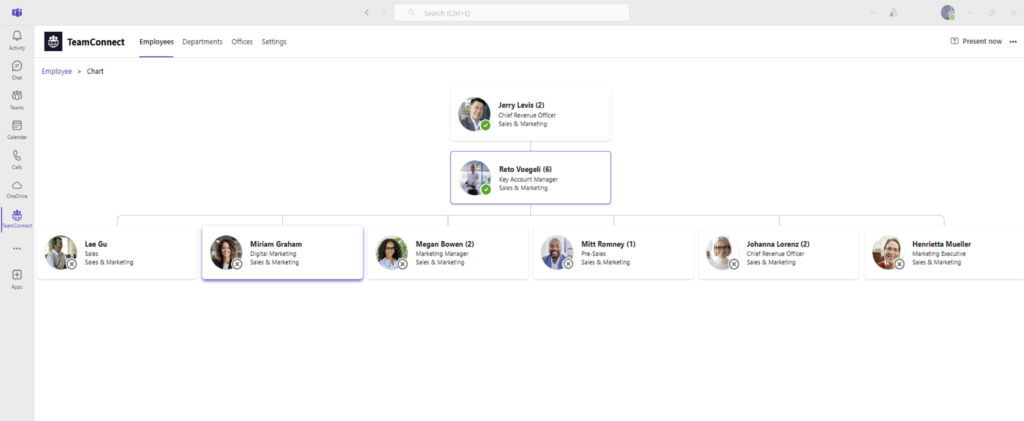
A list shows columns, while a directory shows relationships. TeamConnect overlays both solid‑line (manager) and dotted‑line (functional) reporting paths, so matrix teams see the bigger picture instantly.
2. Search: multi-attribute, & keywords
Microsoft SharePoint filters rely on left-to-right matches. In contrast, TeamConnect indexes names, job titles, skills, languages, functions, roles, workplaces, and keywords. As a result, average lookup time fell from 25 seconds to 5 seconds in a recent pilot—an 80 % improvement.
3. Actionability: one-click collaboration
Specifically, each profile embeds “Chat”, “Call”, “Email”, “Phone numbers”, and “Schedule” buttons. Users act in context instead of copying names back into Microsoft Teams chat.
4. Mobile‑first symmetry
Because TeamConnect inherits Microsoft Teams’ responsive canvas, employees get the same search‑and‑act flow on iOS and Android—no extra mobile development, no separate app store approval.
5. Security & compliance baked-in
TeamConnect stores your people and organization records in SharePoint Online within your own Microsoft 365 tenant. It then reads them through the Microsoft Graph API, under the permissions your administrator consents to. Moreover, Cubeet does not use your data to train foundation models.
6. Governance automation
Finally, the Subscription and Platform Catalogs let IT map job roles to licenses. When a joiner, mover, or leaver arrives, TeamJML AI turns the change into an approved ticket for the service desk, with every task confirmed—something a plain list cannot do.
Solution Lens: How TeamConnect Elevates Microsoft Teams Users
|
Capability |
Microsoft SharePoint List |
TeamConnect |
|---|---|---|
|
Real-time presence, workplace, and local time |
✖︎ |
✔︎ |
|
Profile depth (employee, department, office) |
Basic |
Rich cards |
|
Dynamic org-charts |
Manual Visio |
Interactive drill-down |
|
Multi-attribute search |
Column filter |
Advanced search |
|
One‑click chat/call/email |
View only |
In‑context actions |
|
Role‑based license & app catalogs |
✖︎ |
✔︎ |
|
Employee self-service |
✖︎ |
✔︎ |
|
Admin settings & roles |
List permissions |
✔︎ |
|
Bi-directional Microsoft Entra ID sync |
✖︎ |
✔︎ |
|
Mobile usability |
Limited |
Fully responsive |
Supercharge Communication with a Microsoft Teams Employee Directory
Are you ready to see how an Employee Directory can streamline team collaboration and boost productivity?
Then explore Cubeet’s Employee Directory and discover the difference TeamConnect can make in keeping your workforce connected.
Why a Native Microsoft Teams Employee Directory Matters
-
Five‑minute deployment Install straight from the Microsoft Teams Store—no servers, no configuration, no CSV uploads.
-
45+ languages The UI also picks up each user’s Microsoft Teams theme, language, and regional settings.
-
Matrix‑aware hierarchy Shows dual solid- and dotted-line relationships, especially for consulting or agile squads.
-
Time‑zone intelligence Flags local hours and public holidays so that nobody gets a 3 a.m. ping.
-
AI agent (TeamConnect AI) Ask “Who in Munich speaks Japanese and knows Power BI?” and then get a ready-to-chat shortlist.
-
Microsoft 365 App Compliance Cubeet’s publisher attestation is on Microsoft Learn. Also, Cubeet does not use prompts or answers to train foundation models.
Behind the scenes, TeamConnect also uses the Microsoft Graph API.²
Business Impact
| Metric | Typical enterprise (5,000 users) | Source |
|---|---|---|
| Lookup speed | 25 s ➜ 5 s (–80 %) | Cubeet pilot data |
| Hours saved per month | ~1,800 h (20 s × 3 look‑ups × 22 days × 5,000 users) | Calculation |
| Onboarding time | –40 % (one week) | HR case study |
| License waste released | 6‑figure USD annually | Finance model |
| Employee engagement uplift | +18 % productivity | Gallup/Firstup³ |
Moreover, high engagement correlates with 23 % higher profitability³. Therefore, by eliminating “app-switch friction” and surfacing context in a single click, TeamConnect supports that engagement.
Ready to Transform Your Microsoft Teams Employee Directory?
Book a personalized demo today and experience firsthand how TeamConnect empowers your teams to stay connected, efficient, and fully aligned—no matter how rapidly your organization evolves.
Book a Demo
Access TeamConnect Employee Directory Software
Visit the Microsoft Teams Store or Microsoft Marketplace to locate TeamConnect.
Start a 30-Day Free Trial
Then, in the Microsoft Teams Store, click Buy a Subscription, or in Microsoft Marketplace, click Get it now. During the trial, you won’t be charged; Microsoft will send reminder emails, and you can cancel the trial anytime.
“A connected workforce isn’t just efficient—it’s unstoppable.”
End-notes
-
Business of Apps, Microsoft Teams statistics, March 2025. businessofapps.com
-
Microsoft Learn, Get presence with Microsoft Graph API, 2023. Microsoft Learn
-
Firstup, Employee engagement key to company success, 2024. firstup.io
Related Resources
Frequently Asked Questions About Employee Directories vs Microsoft SharePoint Lists
Can Microsoft SharePoint Lists work as an employee directory?
Microsoft SharePoint Lists can store employee contact information, but they lack the features that make a directory useful at scale: AI-powered search, interactive org charts, real-time presence, one-click communication, HRIS integration, lifecycle automation, and role-based visibility. Still, a Microsoft SharePoint list can work as a simple contact list. However, once people need to find colleagues by skill, language, or location, a dedicated directory is the better fit.
Why is a native Microsoft Teams employee directory better than Microsoft SharePoint?
A native Microsoft Teams employee directory runs where employees already work — inside the Microsoft Teams sidebar, in channel tabs, and from chat. As a result, there is no browser switch, no separate login, and no new app to learn. It also integrates with Microsoft Teams features like presence, calling, chat, and meeting scheduling that Microsoft SharePoint cannot access natively.
How does TeamConnect AI compare to a Microsoft SharePoint-based directory?
TeamConnect AI connects to 50+ HRIS with pre-built connectors, provides AI-powered people search, offers an interactive org chart, ships with 50+ Agent roles that determine what the agent may answer for each user, includes lifecycle automation via TeamJML AI, and runs natively inside Microsoft Teams and Microsoft Outlook. In contrast, a Microsoft SharePoint list requires manual data entry, has no org chart, no HRIS integration, no lifecycle automation, and no role-based visibility.
Can I migrate from a Microsoft SharePoint employee list to TeamConnect AI?
Yes. TeamConnect AI supports CSV import, so you can export your Microsoft SharePoint list and import it as a starting point. But the better approach is to connect directly to your HRIS and Microsoft Entra ID — this gives you accurate, automatically-maintained data instead of migrating potentially stale Microsoft SharePoint data.